
HOW TO BE MORE YOU

Courtesy Death to Stock
By Dany Garcia
6 Minute Read
Self-improvement has taught women to constantly subtract from themselves. What if the objective isn't becoming better, but becoming more yourself?
I think often about the tragedy of sameness. In society and culture today, individuality can be melted down into a commonality, and the algorithm not only feeds it, it rewards it.
I have built a business portfolio around developing talent and brands, and I am always thinking about differentiation—that special spark that says, "Yes, this is the ‘why’ of its existence." Whether I am looking at my investments, my daily workouts, my productions, or my brands, I look to activate the uniqueness of each and push it out into the world. My job is engineering and activating the joy of distinction.
Sameness impacts daily humanity. We are all individuals, and there are sparks inside all of us that we can bounce off one another. Not only is that interesting, it's a vital aspect of growth — we need people who don't think exactly as we think, because that's how we develop ourselves and experience the richness of each other. Coming from a place of happiness, self-awareness and self-trust in who we are as people, that's an exciting way to be: leaning into our own unique version of different.
So here is the problem: it can be hard for women to live this way. We are in a patriarchal society, and on top of that, we experience narratives from our communities; we inherit biases from our parents about who we should be. As we move through life, we are told what is appropriate and become visually bombarded with messages about how we should look. There is so much external conversation that it quiets the internal dialogue we have about who we actually want to be. We end up inheriting narratives when we should be writing our own stories.
“If your pursuit of wellbeing keeps asking you to remove the things that make you feel most alive, I'm not sure that's wellbeing at all.”
At 57 years old, I look back on my experience during my Merrill Lynch years and I see a period of time where I was not my whole, true self. The narrative I assimilated to was that of a financial consultant. I worked hard to adapt to it, from how I needed to dress to how I needed to speak; I now realize there was no space for a unique Dany in that. The last 20 years have been the most transformative in undoing those learned behaviors to find out who I actually was and what I actually liked, because that was necessary. I needed to do it so I could write my own story.
We have to detach from our adopted identities to do this. We have to assume authorship of our own story and reclaim it as our own, and when we do that, we can start to build a life that feels authentic to us. It's critical that as women we do this. The simple fact is this: women rule. I love women, truly. I think the more of us who recognize who we truly are, the greater the impact we can have on and within this universe — women can change the world, and we can change society, as well as ourselves.
In a world set up for conformity, the only way forward is for us to be ourselves. In a world that tells us how we should think, how we should behave and even what we should buy, the only way forward is for you to be more you. In a world of noise, the only way to find the silence is to listen to your own intuition and let it light your path. Don't let an algorithm define anything about you.
The first step in amplifying our own self-discovery is paying attention to our own glimmers of interest. To do that, we have to create an environment for discovery, allow ourselves to learn what drives our excitement, our appetite, our curiosity, and then lean in. You don't need 20 glimmers — you just need one. For me, that glimmer was bodybuilding, and when I leaned into it, it opened up an entire universe that impacted everything else I did.
But following a glimmer means believing in it before you have any proof it will lead anywhere, and that takes a little self-trust to begin with. Building it allows you to step back from distractions, tune into yourself and find yourself on a frequency where you can zone in on the soundbars that actually do serve you. It's important here not to talk negatively to yourself — give yourself absolute permission to ignore all the negative voices, your own included. To write your own story, you need to lead with compassion and self-love, and you need to become the most important authority on the subject of you.
“We have to assume authorship of our own story and reclaim it as our own, so we can build a life that feels authentic to us.”
Achieving a mental quietness is the antithesis of societal noise. That quietness creates space for awareness and self-expression, and once you have that, you have the ingredients to create your own experience and your own story. Know that you are a good person, that it is not indulgent to spend time on yourself, or with yourself, and that if you spend a little time here piquing your curiosity, it will lead you somewhere. Commit to your own enjoyment and nourish it, because five or ten minutes spent doing something you are passionate about can wipe out eight hours of drudgery.
Speaking of drudgery, optimization culture can make wellbeing feel like a grind. What if it didn't? What if you ignored the health advice lavished on you by the TikTokkers or the Instagrammers, or even ignored the algorithm altogether?
Being anti-optimization allows you to focus on your actual enjoyment. Our personal needs and glimmers are different, so there is no one-size-fits-all approach, and what we each need changes at different times of the day, or different times of the month. When you notice yourself, your curiosities and your cravings, you begin to notice what you need and the opportune moments that can give you an extra boost. I call it my very specialized hierarchy of needs: my husband Dave telling me I look beautiful before I leave the house, a spicy margarita with dinner, or my curated outfits that I spend time developing, cataloging and styling.
Optimization shouldn't be making us miserable or starving us of fun. If your pursuit of wellbeing keeps asking you to remove the things that make you feel most alive, I'm not sure that's wellbeing at all. Maybe the question isn't, What else should I eliminate? Maybe it's, What can I add that makes me feel more like myself? That is the kind of optimization I'm interested in: not becoming less, but discovering what deserves more. More you.
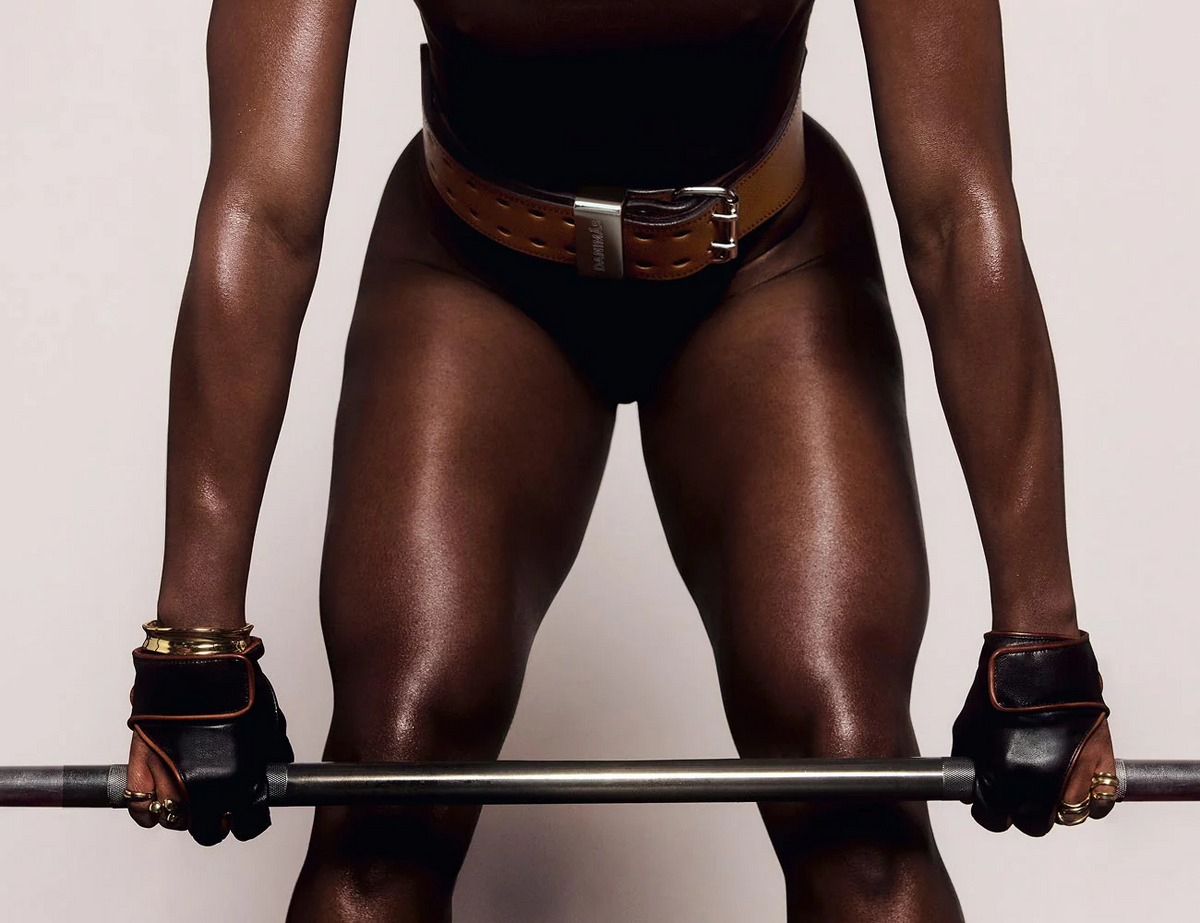
For me, one of those things was weightlifting. It's an excellent glimmer to lean into because the outcome is undeniable — if you lift X, you gain Y, a fact no one can take away from you, and that alone helps eradicate imposter syndrome. A bad session still counts as a win, and a great one can prove you can lift heavier than you could two weeks earlier.
The gym is a safe space for agency. In training, you become dialed into your needs, learning to pay attention to what helps you fuel, what helps you recover, and ultimately, to pay attention to yourself.
“The simple fact is this: women rule. The more of us who recognize who we truly are, the greater the impact we can have on this universe.”
Strength training is not something you can simply add to your plate, however. You have to prioritize. Women are taught that we need to develop boundaries all the time, but boundaries can be hard to implement when they remain abstract — strength training makes them physical. If you want to become stronger, you have to make time to train, you have to eat in a way that supports you, you have to recover, and you sometimes have to say no to something else. That's what makes training different from simply adding another activity to your calendar: the commitment has consequences. Your body eventually becomes evidence of the promises you kept to yourself, and your muscular growth is proof that those boundaries were worth upholding.
That proof matters, because so much of what women are taught about progress points in the opposite direction. Fitness culture, and society more broadly, has often taught women that becoming better requires becoming smaller: smaller bodies, smaller appetites, smaller needs, smaller voices. At Danimás, we reject that narrative. The story where a woman becomes smaller is a tragedy, and becoming ourselves shouldn't be the happy ending either, something finally revealed in the closing pages after a lifetime spent trying to earn it.
I want that revelation in chapter one. Let the story begin with the woman emerging from the chrysalis, already whole, already herself, and then give her the rest of the book to find out just how expansive she can become.
The objective was never to become better. It was to become more you.


